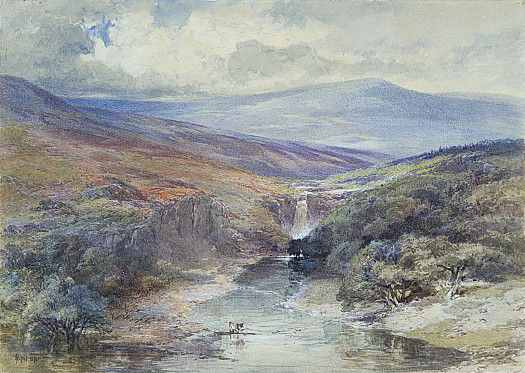
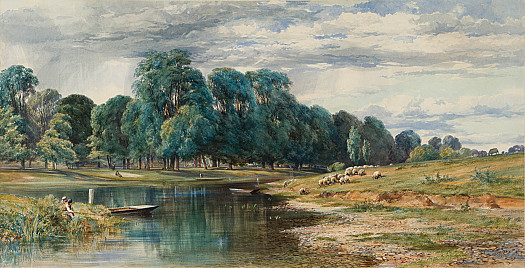
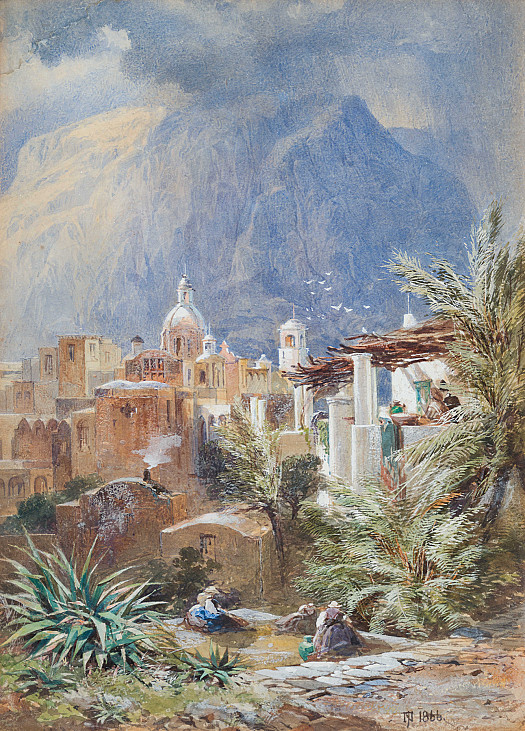
Paul Jacob Naftel was born on 10 September 1817 in Guernsey, to parents Paul Naftel and Sophia Bird. While neither parent was artistic, his father sold artist materials and prints on the island. From an early age, Naftel showed talent for drawing, and he taught himself how to paint by carefully copying reproductions of J M W Turner and John Varley watercolours. Another early influence was James Duffield Harding, whose books he greatly admired as a child. Despite being self-taught, by the time he was twenty, he had been appointed as the drawing teacher at Elizabeth College in Guernsey.
In 1846, Queen Victoria visited Guernsey and Naftel’s watercolour of the event was published in The Illustrated London News. The painting was widely reproduced and highly praised, and marked the beginning of his career outside of the Channel Islands.
Paul Jacob Naftel was first married to Elizabeth Robilliard, who died in 1849, aged just 39.
After her death he met Isabel Oakley, the youngest daughter of Octavius Oakley, on one of their visits to Guernsey. Both father and daughter were watercolour artists from London. In 1853, they married in Dorking, Surrey. Together they had two sons; Cecil Oakley Naftel and Percy Hartley Naftel, and a daughter, Maud.
Paul Jacob Naftel began exhibiting with the Society of Painters in Water-Colours from 1850, and in February 1856 was elected an associate. He was made a full member three years later in June 1859. The following year he travelled to Italy with his wife on a year-long painting tour, the first of many trips there.
In 1862, he illustrated The Channel Islands by David Ansted and Robert Gordon Latham. It included 59 illustrations, and established his reputation as one of the most successful artists from the area.
In 1870, he moved to London and lived with his family at St Stephen’s Square, Westbourne Park. From there he would travel for ‘sketching seasons’ in the Scottish Isles, Ireland and North Wales. He painted a wide range of landscapes across the United Kingdom as well as further afield, including visits to the Pyrenees in 1881.
In 1884, Naftel moved to a studio house designed by J P Seddon on Elm Park Road, Chelsea. He continued teaching in London from this studio and his notable pupils included Rose Barton, Mildred Anne Butler and Kate Prentice. In 1889 the Fine Art Society held a solo exhibition of Paul Jacob Naftel’s artwork. It was at the height of his popularity and commercially his works were incredibly successful. In the same year it was remarked that ‘it is rarely that a drawing of his is left unsold after private-view day’. However, in 1890, it was reported that Paul Jacob Naftel was ‘suddenly stricken down with paralysis’, leaving him without the use of his hands and unable to paint. He moved to Twickenham and isolated himself at home, only making the occasional exception for visitors. His daughter Maud had since followed her father to become a celebrated artist, but died aged just 34 in 1891. Shortly after, Naftel died in Twickenham on 13 September 1891. His studio sale was held at Christie’s in April 1892.
His work is represented in the collections of the V&A; and the Ashmolean Museum (Oxford).