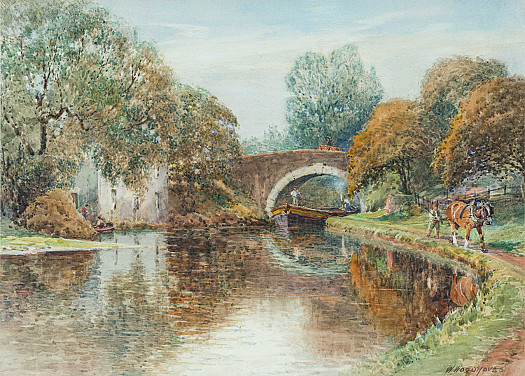
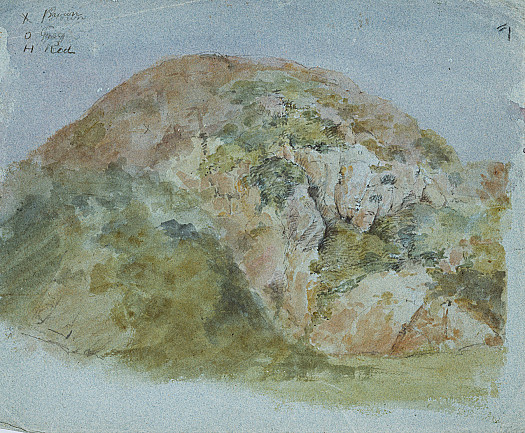
William Woodhouse was an English painter well-known for his highly detailed depictions of animals, particularly dogs and horses, within the British sporting and rural tradition.
William Arnold Woodhouse was born on 1 October 1857 in Poulton-le-Sands, Lancashire (now part of Morecambe), into a fishing family and remained closely connected to this region throughout his life.
William Woodhouse showed artistic promise from an early age. He received his training at the Lancaster School of Art but was largely self-taught in the area of animal painting. Although he painted a range of subjects, including landscapes, marine scenes, still lifes, and occasional portraits, he is best known for his animal paintings. His style was largely influenced by the Victorian animal painter Sir Edwin Landseer. Like Landseer, Woodhouse captured his subjects with a strong sense of character and presence, especially when painting hunting dogs and horses.
His approach to learning included direct anatomical study, visiting slaughterhouses to better understand animal forms which contributed to the realism of his work. He worked primarily in oils before World War I and shifted to watercolours and gouache afterwards.
William Woodhouse started exhibiting work early in his career, first showing at the Lancaster Exhibition at the age of twenty-four and continuing to exhibit there until 1927. He also exhibited at major institutions, including the Royal Academy in 1889 and 1911, the Royal Society of British Artists and the Royal Scottish Academy.
After his marriage in 1892, Woodhouse lived in Kenilcote, a house which he designed himself, and was portrayed in his painting The Reaper. His son Ronald Basil Emsley Woodhouse was born in 1897, he would later become a notable painter and etcher. Woodhouse’s reputation remained largely regional as he rarely travelled or worked outside Lancashire. Despite being associated with northern England, he travelled abroad on at least one occasion, undertaking a tour of the Near East in 1899, visiting Greece, Turkey, and other parts of the Mediterranean. In 1902, he moved to Auburn Court in Heysham, a more rural setting that further inspired his work.
William Woodhouse achieved success during his lifetime, receiving commissions for sporting and animal subjects and producing works that were valued for their technical accuracy and expressive character. He died on 13 January 1939 and is buried with his wife at St Peter’s church in the village of Heysham, near Morecambe, Lancashire.
His work is represented in the collections of Lancaster City Museum and the Lancaster Maritime Museum.