(click image to enlarge)
When the Second International (an organization formed in 1889 by socialist and labour parties who wished to work together for international socialism) was relaunched after the First World War, the ILP was involved in the organising discussions. However, the majority of members saw the International as compromised by its support for war. The ILP disaffiliated from the International in August 1920. Meanwhile, the right-wing leadership of the ILP, notably Ramsay MacDonald and Philip Snowden, opposed affiliation to the newly formed Third International, even though a great deal of sympathy was evidenced within the ILP for Soviet Russia. A compromise was sought whereby the ILP proposed to affiliate to the Third International on condition it need not accept the idea of armed revolt - a proposal rejected by the Third International.
The "centrism" of the ILP, caught between the reformist politics of the Second International and the revolutionary politics of the Third International, led it to leading a number of other European socialist groups into the "Second and a Half International" between 1921 and 1923.
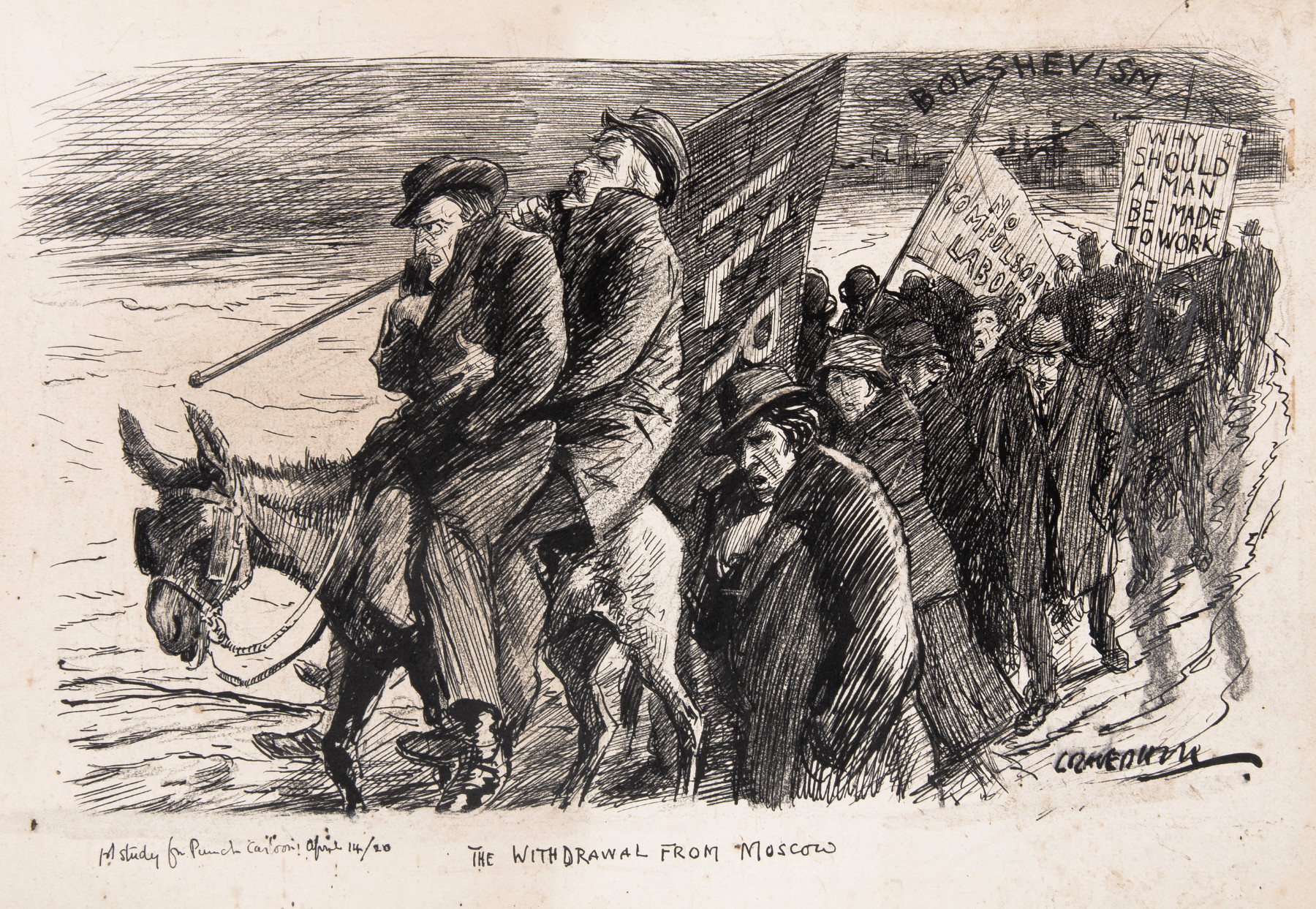
Example of the Soviet policies on compulsory Labour:
April 6 - 15 1920, Third All-Russian Congress of Trade Unions.
Trotsky declared that "the militarisation of labour . . . is; the indispensable basic method for the organisation of our labour forces" . . . "Is it true that compulsory labour is always unproductive? . . . This is the most wretched and miserable liberal prejudice: chattel slavery too was productive". . . "Compulsory slave labour . . . was in its, time a progressive phenomenon". "Labour . . . obligatory for the whole country, compulsory for every worker, is the basis of socialism". "Wages . . . must not be viewed from the angle of securing the personal existence of the individual worker" but should "measure the conscientiousness, and efficiency of the work of every labourer".
Trotsky stressed that coercion, regimentation and militarisation of labour were no mere emergency measures. The workers' state normally had the right to coerce any citizen to perform any work, at any lime of its choosing. With a vengeance, Trotsky's philosophy of labour came to underline Stalin's practical labour policy in the thirties.
Philip Snowden
Philip Snowden, the son of a weaver, was born in the village of Cowling, in the West Riding of Yorkshire on 18th July 1864. He was brought up as a strict Methodist and never drank alcohol. While researching a paper on the dangers of socialism for the Keightley Liberal Club, Snowden became converted to this new ideology, left the Liberal Party and joined the local branch of the Independent Labour Party (ILP). Snowden soon developed a reputation as a fine orator and for the next few years he travelled the country making speeches for the ILP. He drew large crowds and only Keir Hardie was considered his equal as a platform speaker.
In 1899 Snowden was elected to the Keightley Town Council and the School Board. He also served as editor of a local socialist newspaper. Snowden continued to travel the country and in 1903 was elected as the national chairman of the Independent Labour Party and the Labour MP for Blackburn in the 1906 General Election. In the House of Commons Snowden developed a reputation as an expert on economic issues and advised David Lloyd George on his 1909 People's Budget.
When Ramsay MacDonald formed the first Labour Government in January, 1924, he appointed Philip Snowden as his Chancellor of the Exchequer. A position which Snowden returned to in the Labour Government of 1929. During the economic depression in 1931, Snowden suggested that the Labour government should introduce new measures including a reduction in unemployment pay. Several ministers, including George Lansbury, Arthur Henderson and Joseph Clynes, refused to accept the cuts in benefits and resigned from office.
Ramsay MacDonald now formed a National Government with Conservative and Liberal politicians. Snowden remained Chancellor and now introduced the measures that had been rejected by the previous Labour Cabinet. Labour MPs were furious with what MacDonald and Snowden had done, and both men were expelled from the Labour Party.
Snowden did not stand in the 1931 General Election and instead accepted the title that enabled him to sit in the House of Lords. He died on 15th May, 1937.
mounted
8 & 10 Ryder Street, St James’s, London SW1Y 6QB
gallery@chrisbeetles.com
020 7839 7551
© Chris Beetles Ltd 2026 | Accessibility | Privacy | Sitemap