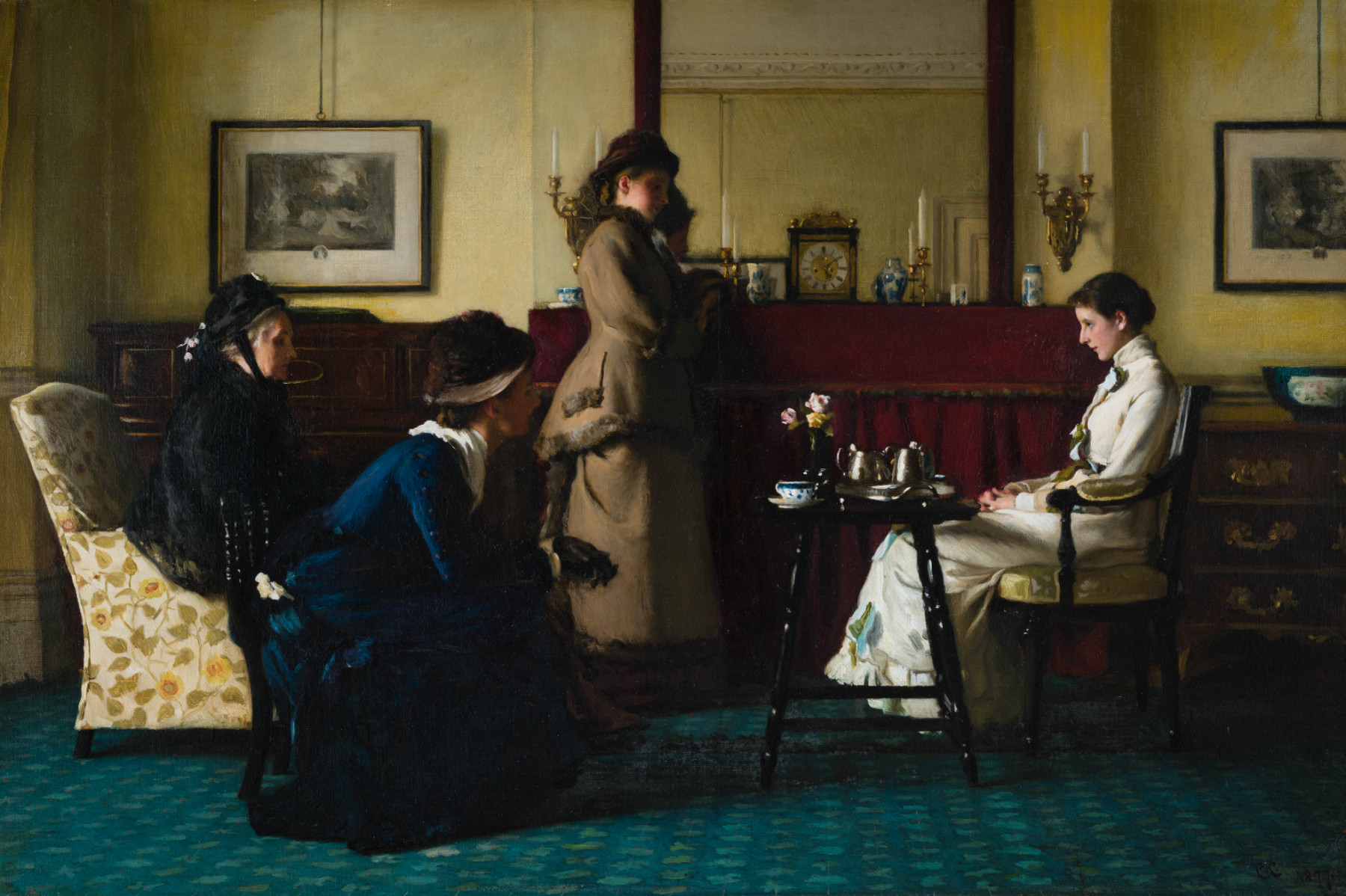
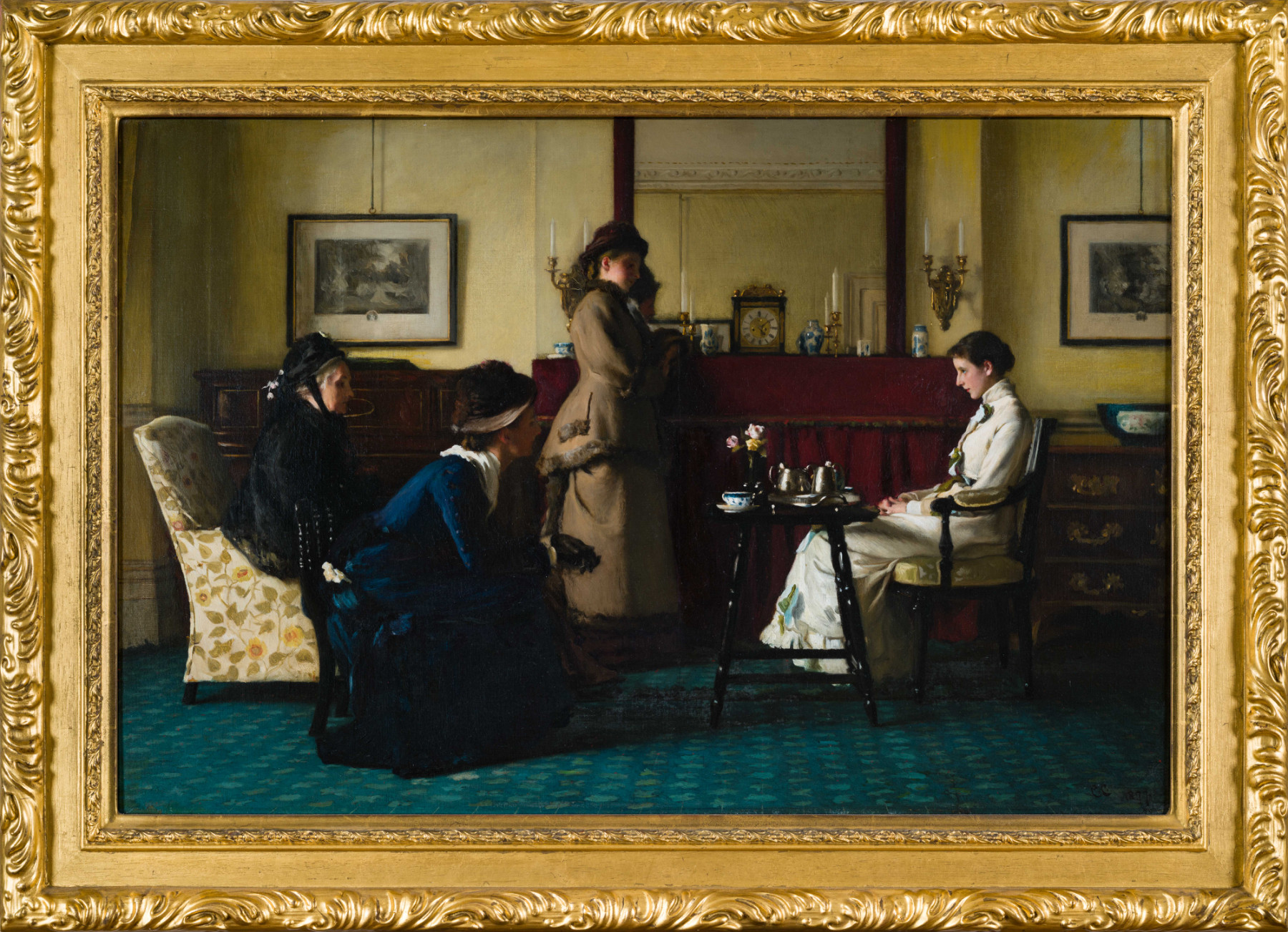
Claude Calthrop’s masterly The First At Home depicts a social custom that had become widespread by the time that it was painted in 1877. Women of the middle and upper classes would announce, by means of calling cards, that they would be ‘at home’ on a particular day of the week, and therefore happy to receive visitors, usually between the hours of three and six in the afternoon, for a period of between a quarter of an hour to an hour, depending on the degree of intimacy between hostess and visitor. This custom was part of a complex set of rituals for ‘calling’, which were laid out in such Victorian guides to manners as How to Entertain; or, Etiquette for Visitors, first published by Ward, Lock, and Tyler in 1876.
However, Calthrop appears to focus on a more precise event: the first ‘At Home’ given by a woman following her marriage. This occurred soon after the honeymoon, and those invited included those who had not attended the wedding itself. The bride would tend to receive them in her wedding dress and serve leftover wedding cake. If this is what Calthrop shows, then he does so with a particularly psychological charge that sets the viewer wondering who the bride’s visitors might be. She is well lit, so that her face, and especially her eyes, can be seen; and, though her attitude seems demure, there is something determined in her gaze. By contrast, the faces of her visitors are placed in shadow so that their expressions are less easy to decipher. As a result, they appear to act together en bloc. If they do so, are they possibly her in-laws intent on judging her performance or, more significantly, her own mother and sisters critical of her match?
Calthrop painted The First At Home two years after his own marriage to Louisa Chance in 1875. It is possible that Louisa was the model for the bride and that the setting is a room in their home at 31 Coleherne Road, Kensington. Another of the artist’s paintings, entitled Young Girl Sleeping, which appeared in auction in 2018, shows the same room with both a chair identical to that on the left and the exact same carpet, and also a clearer view of a bay window. The attention to detail and the bravura handling in the present work prompt comparison with the oeuvre of the French artist, James Tissot, who lived in London throughout the 1870s and, during that decade, produced a number of not dissimilar compositions of the taking of afternoon tea. By extension, it suggests scenes from late Victorian literature, such as those in the novels of Henry James or the plays of Oscar Wilde, in which afternoon tea becomes a significant narrative device. Precisely by emphasising the not taking of tea – with none of the guests partaking – Calthrop brilliantly turns a conversation piece into a stand-off.
8 & 10 Ryder Street, St James’s, London SW1Y 6QB
gallery@chrisbeetles.com
020 7839 7551
© Chris Beetles Ltd 2026 | Accessibility | Privacy | Sitemap