(click image to enlarge)
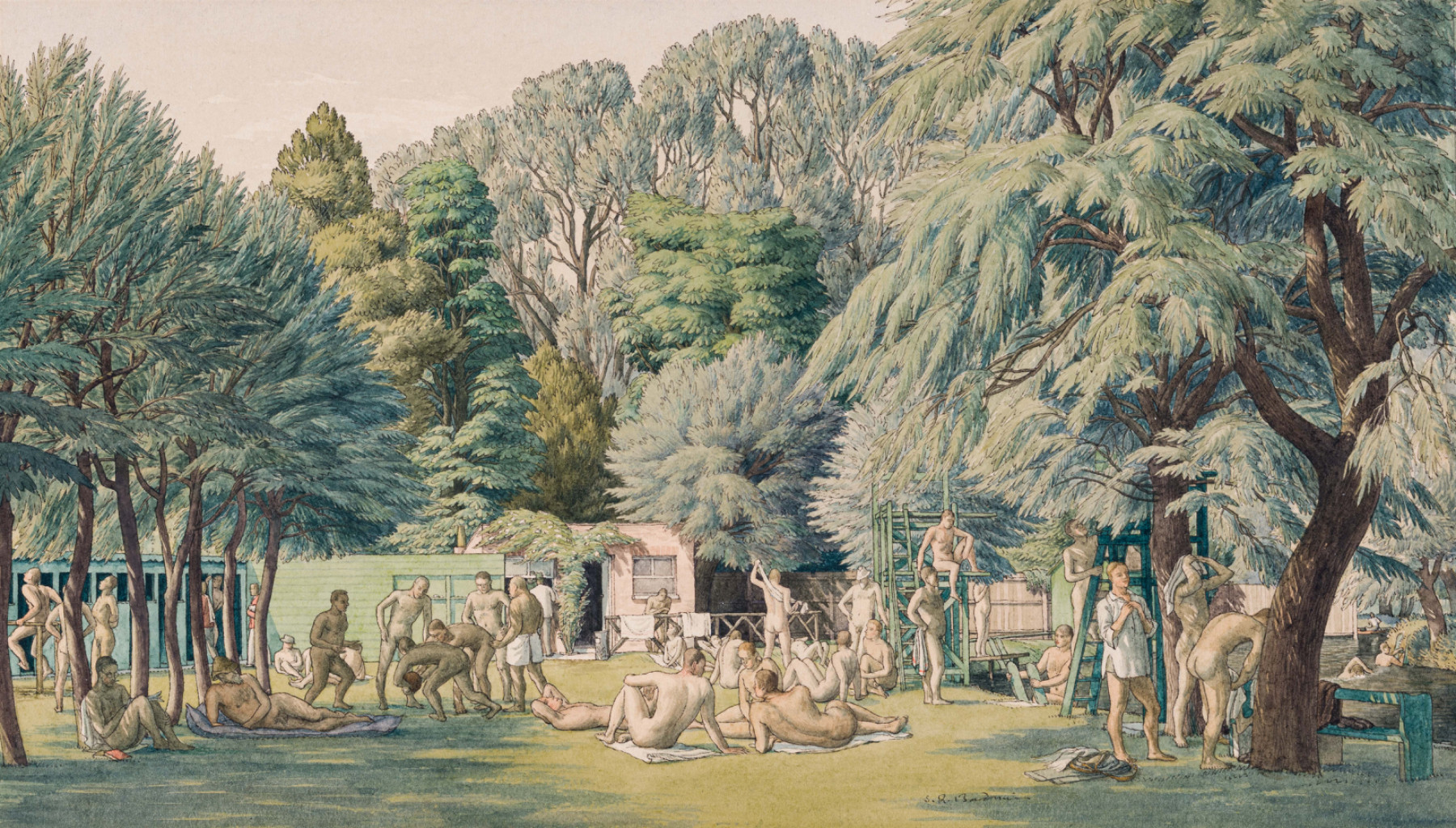
Parson's Pleasure an area next to the path to Mesopotamia that runs alongside the river Cherwell in the south east corner of the Oxford University Parks.
Parson’s Pleasure was traditionally a secluded area for male-only nude bathing, often frequented by university dons. To protect both the men bathing and ladies in passing punts, the area was screened by a high corrugated fence and a track with rollers which allowed for the ladies’ punts to be hauled from the Cherwell and over the rollers, so bypassing the embarrassment of both the swimmers and the passing ladies.
Parson's Pleasure became part of Oxford folklore and is often referred to in contemporary literature. In 1923, Christopher Morley wrote about its charms in a poem (Parsons’ Pleasure, New York: George H Doran Company, 1923) and Anthony Gibbs, in his autobiography In My Time (London: Peter Davies, 1969), describes Parson’s Pleasure as ‘The most enchanting spot in Oxford’ and that often one punt each afternoon would pass with girls ‘scarlet-faced and staring straight before them, would meander by. They did it on purpose, of course. No one paid them the slightest attention. Absolute disdain was the code of behaviour.’
Although the area closed in 1991, its name continues to live on, a local brewery’s ‘Parson’s Pleasure Ale’ and also the Parson’s Pleasure Surprise Maximus, a complex method of change ringing, performed on 12 church bells (2010).
8 & 10 Ryder Street, St James’s, London SW1Y 6QB
gallery@chrisbeetles.com
020 7839 7551
© Chris Beetles Ltd 2026 | Accessibility | Privacy | Sitemap